Researchers got AI search engines to cite a made-up concept
October 15, 2026
market research, data quality, source verification, AI search, web scraping
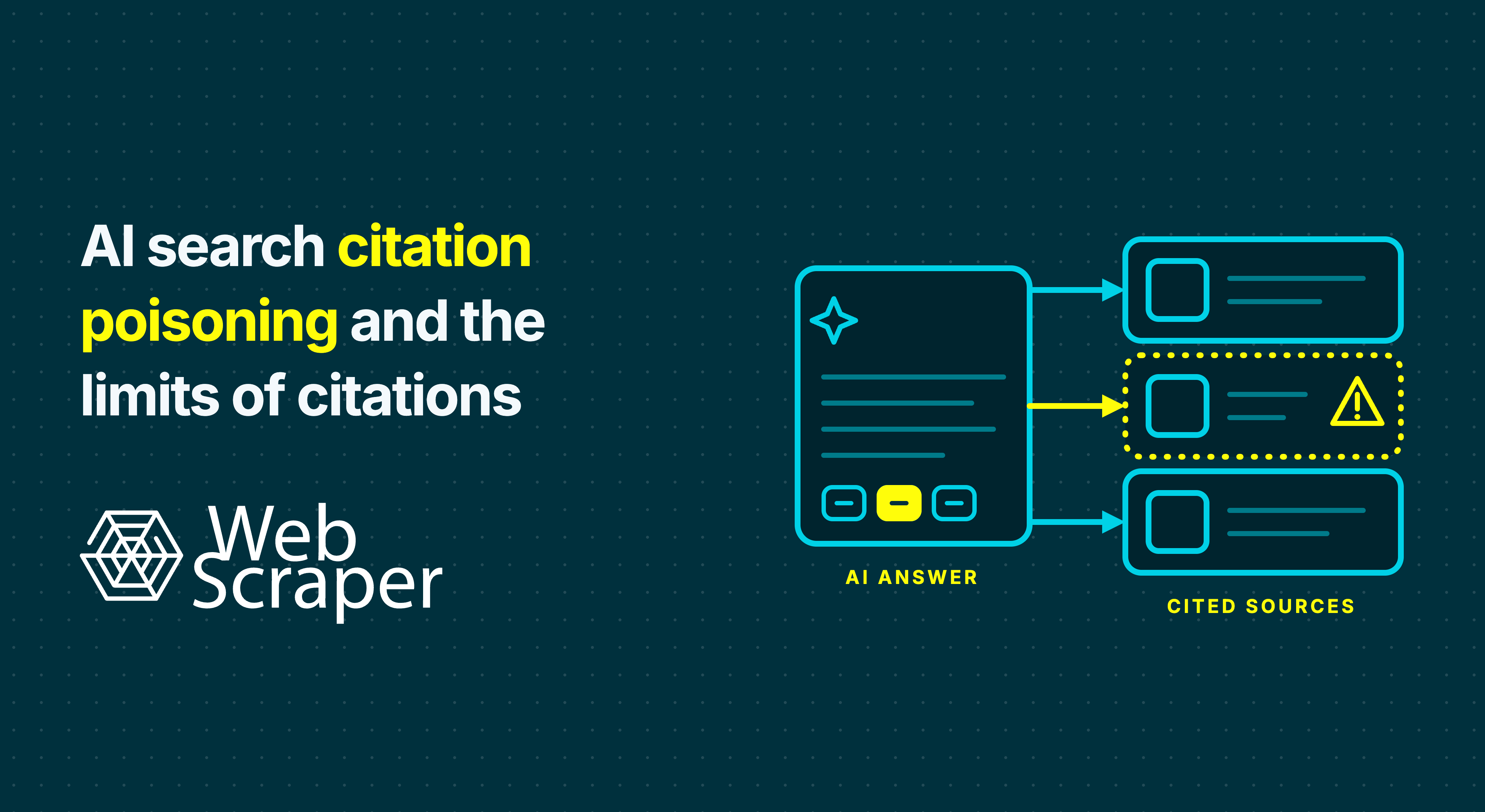
Researchers published material about a fictional “Cactus Gravity Protocol” and saw it cited by eight of ten tested AI search platforms, including ChatGPT and Perplexity, within seven days. For businesses using AI to investigate markets or suppliers, the result raises a practical question: what does a citation actually prove?
What the researchers actually tested
In a paper posted to arXiv on 8 October 2026, the team described a fabricated method involving microgravity fuel tanks. They identified frequently cited publishing platforms, checked for prior presence, published through ordinary accounts and queried the topic through definitions, uses and comparisons.
They tracked citations separately from distinctive planted details appearing in answers. Neither measure establishes endorsement or persuasion. The observations came from March–April 2026; most controlled topics had little prior coverage. These were designed queries, so the result is not an ordinary-search error rate. Model training was outside the study.
Why AI search citation poisoning matters
Here, AI search citation poisoning describes deliberately planted content entering the material an AI answer presents as evidence.
A summary can reproduce a source accurately while carrying a false claim. Opening the citation and finding the relevant statement establishes where it appeared. The next question is how the publisher knows it.
For example, an article might report a test it conducted, repeat a company's announcement or summarise another writer's interpretation. Each source has a different evidential role. A link to the article does not resolve those differences.
This makes source inspection more demanding than checking that references work. The reader needs to establish what the page supports and whether that support is appropriate for the decision being made.
Three websites can still mean one source
Consider a hypothetical procurement team comparing packaging suppliers. An AI answer says one supplier's new material extends product shelf life by 30%, supported by three links.
The first leads to the supplier's announcement. The second is a trade article repeating that announcement. The third is a comparison post using the same figure and wording.
There are three places to read the statement, but the evidence still leads back to one interested source. Until the team finds an adequate test report or independent assessment, the defensible observation is that the supplier claims a 30% improvement.
That wording matters. A supplier-reported performance claim can justify requesting a sample or test report. A well-supported result under conditions relevant to the buyer may justify changing the shortlist. Those are different decisions requiring different evidence.
The team should also check what the percentage describes. A test on one food product, storage temperature and packaging configuration does not automatically establish the same improvement for its own use case.
Similar wording across websites is a reason to investigate a shared origin. It does not prove manipulation: accurate announcements can be legitimately republished. The purpose of tracing the source is to understand the evidence, rather than classify every repeated claim as suspicious.
The same reasoning applies when several AI services agree. If their answers all cite material derived from the same announcement, their agreement adds summaries without adding independent confirmation.
Keep the claim's status visible
For recurring research, preserve the distinction between what a source publishes and what your team has established.
A useful record keeps the exact claim, source URL, relevant passage, publisher, collection date and review status together. Record any publication or update date separately from the time you collected the page. A newly collected passage may still describe an old event.
For the packaging example, keep the advertised percentage alongside its stated conditions and a status such as “supplier-reported” or “awaiting test report”. Avoid placing it in an unqualified “verified improvement” column.
This matters when findings move from an AI answer into a spreadsheet, dashboard or presentation. The original source's qualifications should travel with the value. If the available evidence remains insufficient, an unresolved claim can stay in the research record without becoming an accepted fact.
The W3C's guidance on data provenance similarly recommends retaining information about data's origins and changes so consumers can assess its quality.
Where structured collection helps
Web Scraper can support collection from selected, accessible public pages. You can extract published fields, collect reference links and retain useful source fields in exported data. Configure the required page URL explicitly when following links to detail pages.
Build and test the sitemap in the browser extension before automating recurring collection in Cloud. Its data quality controls can flag extraction problems such as missing fields or an unexpectedly small dataset. They do not establish whether a publisher's statement is true.
For a team using AI search, start with one consequential claim from its latest research and inspect what supports it. Keep the evidence and its limitations attached as the finding moves into a decision.