E-commerce web scraping for product and pricing data
Keep product, pricing and availability data current across the online stores that matter to your business. Web Scraper Cloud runs recurring jobs and delivers structured datasets to your catalog, reporting and commercial workflows.
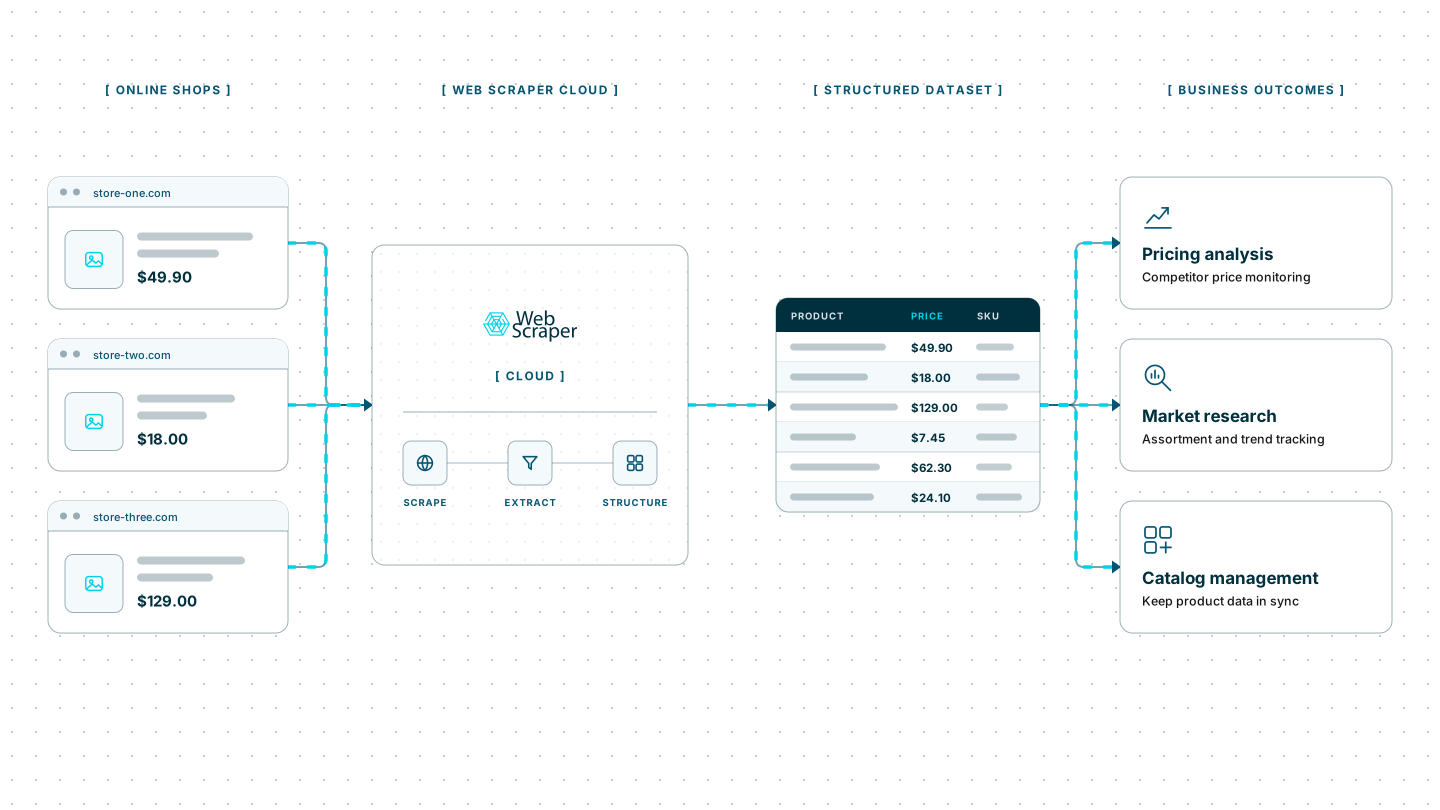
Who e-commerce web scraping is for
Online stores spread product data across category pages, product pages, variants and offers. Web Scraper turns these pages into repeatable datasets for teams that need a current view of products across the market.
| Who it is for | What they follow | Risk of outdated data |
|---|---|---|
| Retailers and e-commerce teams | Competitor ranges, prices, promotions and availability | Responding late to a price reduction, stock gap or assortment change |
| Brands and distributors | Product coverage and presentation across retailer websites | Missing a delisted SKU, incorrect product detail or availability problem |
| Catalog and product operations teams | Supplier products, variants, specifications and stock status | Leaving stale product or variant information in the catalog |
| Data and market intelligence teams | Product ranges across categories, stores and regions | Making decisions with a category or regional blind spot |
A typical e-commerce workflow
A home-appliance distributor needs a weekly view of its products across 18 retailer websites. For each store, it captures the product title, brand, manufacturer part number, variant, current price, promotion label, availability and source URL.
Web Scraper Cloud runs the jobs every Monday and sends the completed data to the company’s storage environment. The distributor’s own system matches equivalent products, compares the latest results with previous runs and flags missing products, availability changes and listing inconsistencies.
Web Scraper handles recurring website extraction and delivery. Product matching, catalog normalization and commercial decisions remain part of the distributor’s own workflow.
Built for the realities of retail websites
Retail websites are rarely simple targets. Prices may load through JavaScript, variants can sit behind menus or clicks, and product ranges may extend across pagination or infinite scrolling. Stores can also apply rate limits, IP blocks, CAPTCHAs and anti-bot systems such as Cloudflare, DataDome and PerimeterX.
Teams need to assemble and maintain headless browsers, a proxy pool, CAPTCHA solving, retry logic, scheduling and monitoring. When a retailer changes its page structure, JavaScript behavior or access protections, that infrastructure and the affected scraper may need further work before the dataset is current again.
Web Scraper Cloud provides that infrastructure as a managed service, combining browser automation, built-in proxy management, automated CAPTCHA handling and retries. It removes the need to operate separate browser, proxy and scheduling systems for every recurring project. Teams can manage target coverage and extraction rules while Web Scraper Cloud runs and delivers the jobs.
Coverage across major retailers and storefronts
The Web Scraper Marketplace includes prebuilt sitemaps for Amazon, eBay, ASOS, Walmart and other major retailers, providing a ready-made starting point for common targets.
Web Scraper can also be configured for public storefronts built with Shopify, WooCommerce, Adobe Commerce, BigCommerce and custom e-commerce systems.
Unusual page structures, location settings or access protections may require additional sitemap or Cloud configuration.
The free trial is the fastest way to set up your target stores, run the first jobs and confirm the required data is reaching your workflow.
Where Web Scraper fits
Web Scraper provides the recurring extraction layer between online stores and the systems your team already uses.
Define the required store coverage
Use the Web Scraper browser extension to create the sitemap for each website. The sitemap defines which pages Web Scraper should visit and which product details should appear in the output.
Run recurring jobs in Web Scraper Cloud
Web Scraper Cloud handles scheduled execution, browser automation, proxies, retries and job monitoring across your target stores.
Jobs can run at fixed intervals or through custom schedules, allowing teams to refresh datasets without repeating the same manual checks. Explore scheduled scraping.
Connect the results to your existing tools
Download completed data as CSV, XLSX or JSON, or send it to Google Sheets, Google Drive, Dropbox, Google Cloud, Azure or Amazon S3.
The Web Scraper Cloud API can connect job execution and data retrieval to catalog systems, reporting environments and internal pipelines. Webhooks notify those systems when a job has finished. View data export options.
curl "https://api.webscraper.io/api/v1/scraping-job/{job_id}/json" -H "Authorization: Bearer {token}"

{
  "product_title": "60 cm induction hob",
  "brand": "Acme",
  "mpn": "AC-IH60-B",
  "variant": "Black glass",
  "price": "429.00",
  "promotion": "Autumn offer",
  "availability": "in_stock",
  "source_url": "https://store-one.example.com/hobs/ac-ih60-b",
  "observed_at": "2026-08-17T06:00:11Z"
}
{...}Ready-made sitemaps for major retailers
Start from a prebuilt retailer sitemap and adjust it to the stores, categories and product fields you need.
Replace manual store checks with scheduled datasets
Move recurring store checks into scheduled jobs and deliver each completed dataset to the systems your team already uses. Start with the retailers that matter most, then extend coverage as the workflow proves useful.