Do you need a proxy for web scraping?
August 25, 2026
web scraping, Proxy management, proxy rotation, proxy
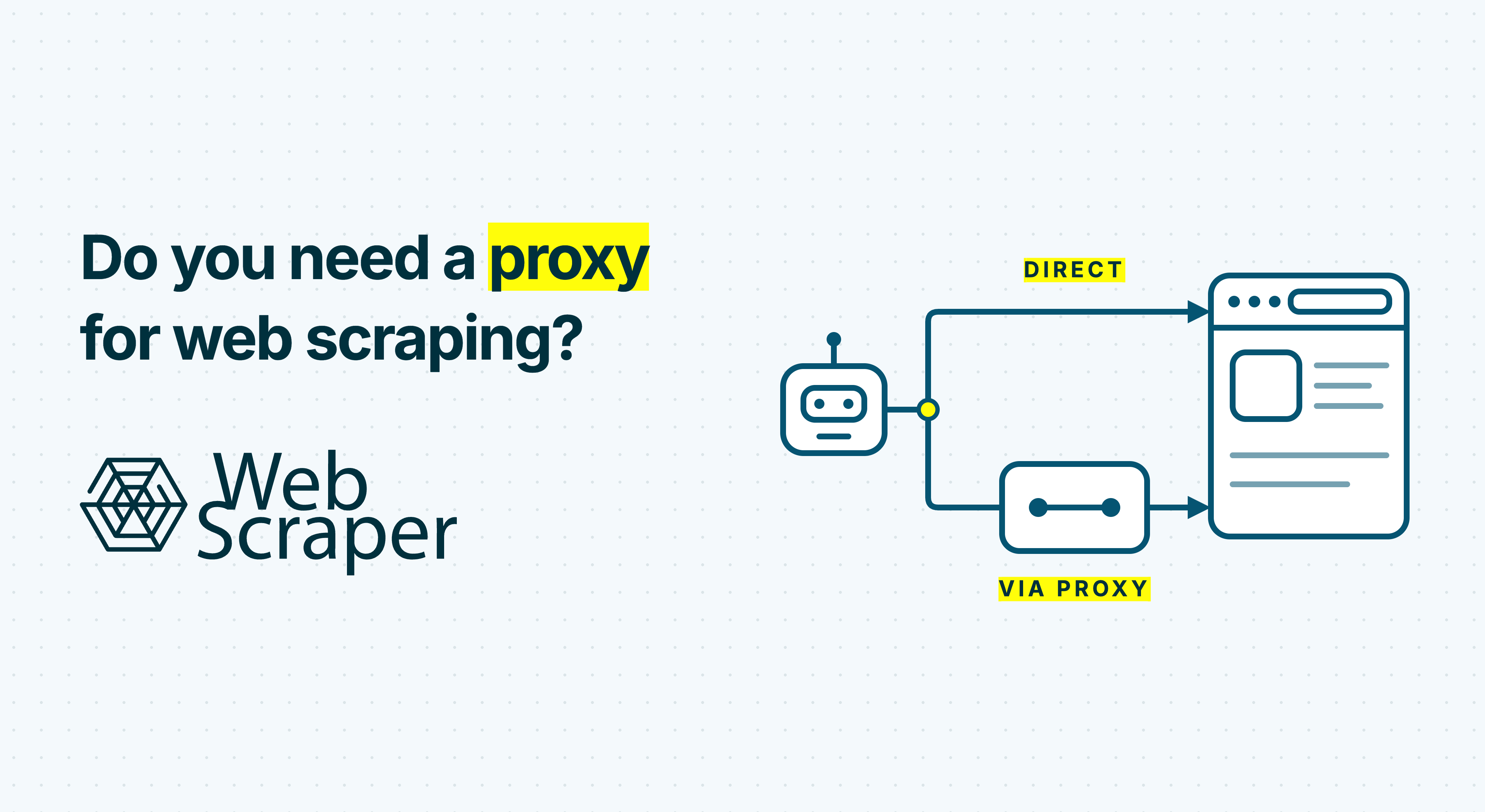
No, not every web scraping job needs a proxy. A small test or occasional collection from accessible public pages may work reliably from your normal connection. Add a proxy when evidence shows that the source IP, network type or location is causing failures, or when repeatable automation would otherwise depend on one route.
Usually, test directly first, use a datacenter proxy when routine automation needs another route, and test residential routing only when controlled results justify the extra cost and complexity.
What a proxy changes
A proxy is an intermediary between the scraper and the target website. The scraper sends a request to the proxy, which forwards it to the destination and returns the response. The website normally sees the proxy's exit IP address rather than the original connection.
That can change three useful things:
- Network identity: requests arrive from a different IP address and network.
- Location: the exit route can originate from a selected country or region.
- Route allocation: a managed pool can replace an unhealthy route or distribute independent requests across several routes.
A proxy does not turn the request into a completely new visitor. Websites can also evaluate cookies, sessions, request patterns, headers, browser characteristics and account state. Changing the IP can improve a job without fixing every access problem. The detailed choices around rotation, sessions and retries belong in a separate guide to proxy management for web scraping.
When you do not need a proxy for web scraping
Start without a proxy when:
- the pages are publicly accessible and appropriate to collect;
- the required content loads correctly from your normal connection;
- a representative sample returns the expected records and fields;
- the job is small, infrequent or still in local development;
- the content does not need to be viewed from another location; and
- the target does not begin limiting or changing responses as the test grows.
Adding a proxy at this point introduces another variable. It will not repair incorrect selectors, broken pagination or missing JavaScript execution. Treat the direct test as a clean baseline, not proof that a larger scheduled job will behave identically. If the baseline repeatedly returns the correct dataset at the intended rate, keep the simpler setup.
Choose the route from evidence
There is no universal page-count threshold at which a proxy becomes mandatory. Choose the least complex route that passes a representative test.
| Starting choice | Use it when | Evidence required before changing it |
|---|---|---|
| No proxy | Direct access returns the expected pages and valid records at the intended small volume | Repeated access, regional or reliability failures attributable to the network |
| Datacenter proxy | You need another route, basic IP distribution or a supported country, and the target accepts datacenter traffic | A controlled test shows that datacenter routes still fail while the driver, pace, session and extraction logic remain fixed |
| Residential proxy or further investigation | Network classification, reputation or precise regional access remains a plausible cause | A representative residential test materially improves correct output enough to justify the added cost |
| Stop and review the job | The data requires bypassing authentication, a paywall or another explicit access control | A proxy does not grant permission or make an unsuitable target appropriate |
Datacenter and residential describe the source of the IP address. Rotation and session duration are separate decisions. Changing IPs during a multi-step flow can disrupt cookies, selected location or session continuity. For the full type comparison, see datacenter versus residential proxies for web scraping.
Signals that a proxy may be needed
Treat these observations as reasons to investigate, not automatic proof that a proxy will fix the job.
| What you observe | What it may indicate | Best next test |
|---|---|---|
Early pages work, followed by repeated 429 responses |
A request-rate, concurrency, account or IP limit | Reduce the rate and concurrency first, then compare a proxy under the same workload |
403 responses, access-denied pages or CAPTCHAs vary by source network |
IP reputation or network classification may contribute | Run a controlled datacenter-proxy test |
| The same URL returns the wrong country's prices, stock or catalogue | Location, cookies or selected page state may affect the content | Test the required proxy country and verify currency, postcode and delivery settings |
Pages return 200, but expected records are absent |
A soft block, consent page, rendering problem or selector failure | Inspect the returned page and rendered state before changing the network |
| Local collection works, but an unattended environment fails | Network, browser execution, timing or session state may differ | Compare screenshots, final URLs, rendering and route one variable at a time |
Timeouts or 5xx responses occur on direct and proxy routes |
The target, route or workload may be unstable | Run a small control sample and avoid multiplying retries |
429 Too Many Requests establishes rate limiting, but it does not prove that the limit is based only on IP address. The server may count by account, cookie, endpoint or another method. Respect Retry-After when supplied, reduce aggregate traffic and retest before adding rotation.
403 Forbidden confirms that the server understood the request and refused it. The status alone does not reveal whether the cause is geography, IP reputation, permissions, session state or site policy. Inspect the response and compare routes under otherwise similar conditions.
The strongest proxy signal is a repeatable difference between comparable tests. One isolated CAPTCHA is weaker evidence than the same URL sample consistently producing valid records through one route and access failures through another.
What a proxy cannot fix
Before paying for a different IP pool, rule out problems outside the network layer:
- Incorrect selectors or navigation: repair the extraction, pagination or link logic.
- Missing JavaScript execution: use the appropriate driver and interaction flow. See how JavaScript-rendered content affects web scraping.
- Incomplete page state: currency, consent, delivery location and authorised sessions may depend on cookies or interactions as well as IP location.
- Excessive collection: reduce concurrency, remove duplicate URLs, cache unchanged pages and stop unnecessary retry loops.
- Authentication and account restrictions: an IP change does not create valid permission, cookies or account state.
- Wrong content behind a successful status: a challenge, consent screen or reduced page can still return
200 OK. Diagnose the actual response instead of counting it as a successful record.
The useful unit of success is accepted data, not completed requests.
Test whether the workload needs a proxy
Use one controlled sequence before committing the full job.
- Define a representative sample and acceptance criteria. Include listing pages, detail pages, pagination, variants and region-sensitive content. Record expected page markers, plausible record counts and fields that must be present.
- Establish the direct baseline. Run the sample locally without a proxy at a conservative rate. Save status codes, final URLs, relevant page markers, screenshots or response bodies, timing and extracted output.
- Classify failures. Separate access failures from empty pages, rendering problems, page-state problems and extraction errors. Do not label every zero-record result as an IP block.
- Reduce avoidable pressure. Lower concurrency, increase the request interval where appropriate, deduplicate URLs and stop retry loops. If this fixes the run, more IPs may be unnecessary.
- Compare a datacenter route. Keep the URL set, driver, sitemap, session requirements, pacing and validation rules fixed. Change only the network route and compare accepted output.
- Test residential routing only with a reason. If network classification or location remains a plausible constraint, repeat the same comparison with residential routing where available. Move only if the improvement is repeatable and material.
- Repeat at production-like volume and set guardrails. A five-page test does not establish reliability for a recurring 50,000-page job. Increase volume gradually, monitor quality and stop or quarantine a run that fails its data contract.
Compare routes using the percentage of URLs that reach the intended page, accepted record count, required-field completion, failed, empty and challenged pages, retry rates and consistency across the intended schedule. Include execution and proxy cost per accepted record when cost affects the decision. A cheap route is not cheap if it produces wrong-region prices or incomplete datasets.
A practical Web Scraper workflow
Web Scraper lets you test the proxy decision using the same extraction workflow:
- Build the sitemap with the free Web Scraper browser extension. Test selectors, pagination and interactions locally, then inspect a varied data sample.
- Use sitemap sync to move the tested sitemap to Cloud for remote execution.
- Run a small Cloud pilot. Web Scraper Cloud includes datacenter proxies, while residential proxies are available as an add-on where applicable.
- Compare the Cloud pilot with the local direct baseline. Configure data quality controls for record count, failed pages, empty pages and required-field completeness.
- If the datacenter result points to a network or location constraint, test residential routing under the same acceptance rules.
- Schedule or API-trigger the job only after the representative test passes, then continue monitoring it. No proxy option guarantees access to every target.
For a daily competitor-price feed, the winning setup is not the one that loads the most URLs. It is the lowest-cost setup that reliably returns the intended market, expected products and usable price fields on schedule.
Use proxies responsibly
A proxy changes routing, not responsibility. Review the website's terms, applicable law, privacy obligations and any permission you have before collecting data. Check relevant robots.txt instructions as part of that review, while remembering that the Robots Exclusion Protocol says these rules are not access authorisation.
Do not use rotation as a reason to ignore clear rate limits or bypass explicit access controls. Apply one traffic budget to the target hostname across all jobs and proxy addresses. The guide to ethical web scraping request rates explains why concurrency and browser subrequests matter alongside the interval between page loads.
Social platforms, LinkedIn and large behind-login projects are not Web Scraper's default fit. A proxy should not be used to force an unsuitable workload through a website restriction.
Start with the simplest route that works
You need a proxy only when it solves a demonstrated network, location or operational dependency. Start directly, validate the dataset and escalate only when a controlled comparison supports the change.
If you want to automate a tested sitemap without building separate browser, proxy and monitoring infrastructure, test the target with Web Scraper Cloud.