Datacenter vs residential proxies for web scraping
August 04, 2026
web scraping reliability, data quality, Proxy management
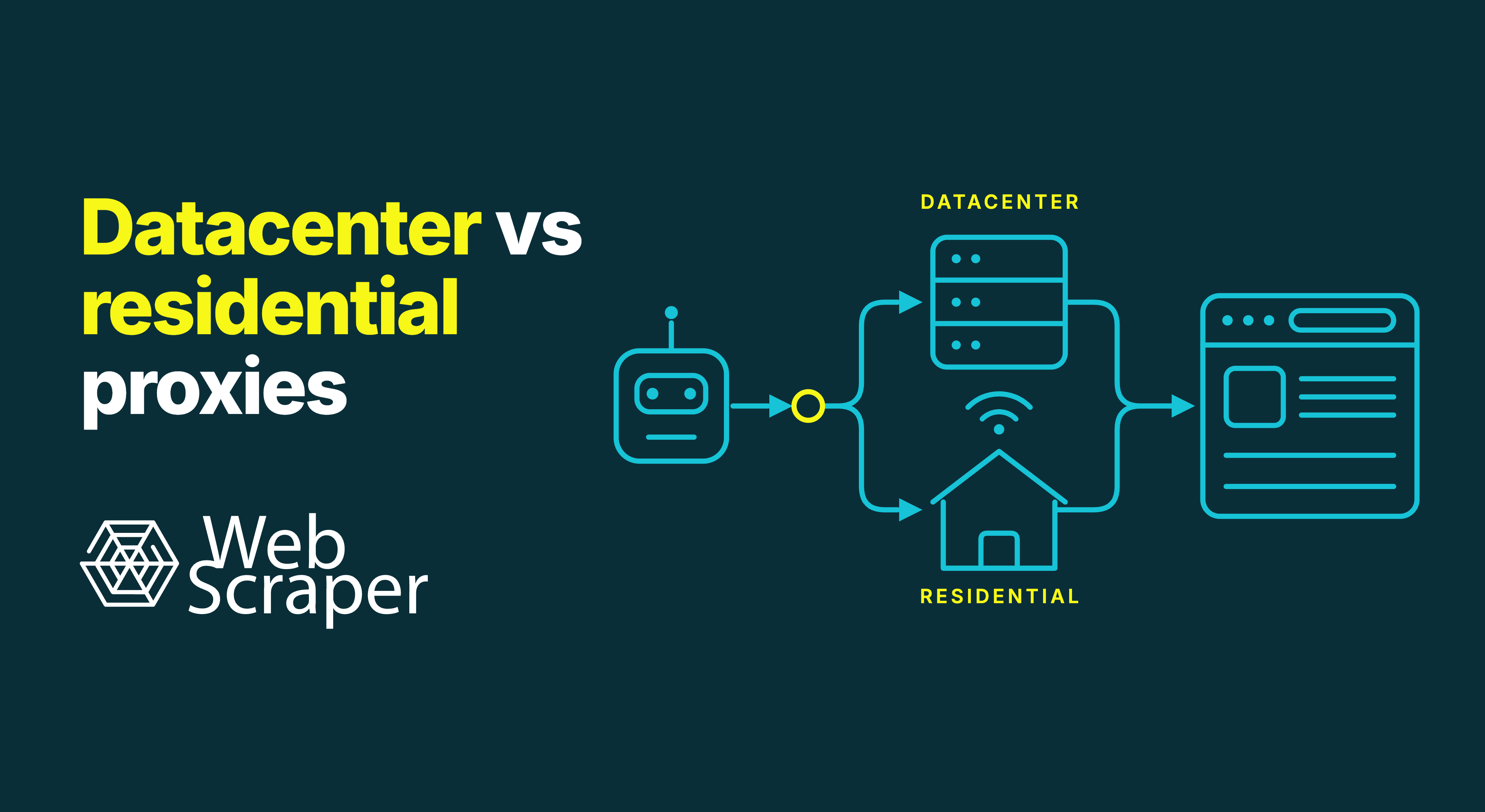
Start with datacenter proxies. Move to residential proxies when controlled testing shows that network classification, IP reputation or location is preventing you from collecting the right pages reliably. Datacenter proxies are generally faster, cheaper and easier to scale, while residential proxies offer broader location coverage at a higher and more variable cost.
The important test is not whether a proxy returns 200 OK. It is whether the scraper receives the expected page and produces valid records at an acceptable total cost. For many production workloads, the best setup is datacenter by default and residential where the evidence justifies it.
Datacenter vs residential proxies at a glance
| Factor | Datacenter proxies | Residential proxies |
|---|---|---|
| IP origin | Hosting, cloud or datacenter networks | IP space associated with consumer internet service providers |
| Typical cost | Lower | Higher, often charged by bandwidth |
| Speed and latency | Usually faster and more consistent | Often more variable across locations and endpoints |
| Network classification | Hosting ranges are relatively easy to identify | Consumer origin can look less unusual, but residential proxy detection exists |
| Pool diversity | Large, but concentrated in hosting networks | Often spread across more ISPs and locations |
| Location coverage | Commonly country or region based | Often broader and more granular, depending on the provider |
| Session stability | Strong with static or dedicated IPs | Strong with static or ISP addresses; rotating peer pools require sticky sessions and endpoint availability may vary |
| Best starting point | High-volume, public and relatively accessible pages | Location-sensitive or demonstrably datacenter-restricted pages |
| Main limitation | A target can distrust the network before considering the individual IP | Higher cost does not guarantee access or correct data |
What a proxy actually changes
A proxy sits between the scraper and the target website. The scraper sends a request to the proxy, the proxy forwards it from an exit IP, and the website returns the response through the same route.
The target can normally observe network-level information including:
- the exit IP address;
- its autonomous system number, or ASN;
- the network owner and connection type;
- the apparent location;
- the IP's reputation and recent history;
- request volume associated with the IP or wider network.
Datacenter traffic can be easy to classify because major cloud providers publish their address space. AWS, for example, publishes a current JSON list of its IP ranges specifically so AWS traffic can be identified or filtered.
Residential traffic is not impossible to identify either. MaxMind's IP intelligence schema includes hosting-provider and residential-proxy indicators, along with residential-proxy confidence, recent sightings and provider identification for a subset of networks.
More importantly, the proxy does not replace the rest of the request identity. The target may still evaluate headers, cookies, browser and TLS fingerprints, JavaScript execution, navigation order, timing and behaviour. Cloudflare documents a combination of heuristics, JavaScript detections, machine learning, malicious fingerprints, headers, session characteristics and browser signals.
A residential proxy can improve the IP portion of a scraper's profile. It does not make the rest of the profile coherent.
Transport support can matter too. Traditional proxy configurations may cause a browser to use HTTP/2 even when the target supports HTTP/3, which creates another observable difference. Our examination of HTTP/3 proxy compatibility covers that particular networking rabbit hole in more detail.
What is a datacenter proxy?
A datacenter proxy routes requests through an IP address hosted on server or cloud infrastructure rather than a household broadband connection.
Providers can operate large datacenter pools on fast connections, offer predictable capacity and replace unhealthy endpoints relatively easily. For accessible websites, this often means high throughput at a low cost per request.
The trade-off is classification. A website can identify the ASN or published range associated with the address and apply stricter rules to hosting traffic. It may therefore challenge an entire hosting range even when an individual IP has behaved appropriately.
Datacenter proxies can be:
- shared, with multiple customers using the same IP pool;
- dedicated, with an address reserved for one customer;
- static, keeping the same exit IP;
- rotating, selecting different exits according to a rule.
This matters because a dedicated static datacenter address behaves very differently from a large shared rotating pool. Calling both simply "datacenter proxies" is accurate, but not especially diagnostic.
What is a residential proxy?
A residential proxy routes requests through IP space associated with consumer internet service providers. Depending on the provider and product, traffic may pass through household devices, other consumer-connected endpoints or infrastructure using ISP-issued addresses.
To the target website, that network origin can resemble an ordinary internet connection rather than a cloud server. This can improve access when a site applies stricter rules to hosting networks. Residential pools also tend to offer broader location options, which is useful when prices, inventory, search results or availability vary by region.
Residential products are not all built the same way. A rotating peer network differs from a static residential or ISP proxy, where ISP-issued addresses are hosted on server infrastructure. Sourcing, consent, uptime, location accuracy and session duration can also vary between providers.
Residential does not mean undetectable. Protection systems can identify known proxy networks, observe implausible location changes or recognise automation through signals unrelated to the IP. Paying more for the address does not award the scraper a diplomatic passport.
Where mobile proxies fit
A mobile proxy uses address space assigned to a mobile network operator. Mobile carriers commonly place many subscriber connections behind shared public IPv4 addresses using carrier-grade network address translation, or CGNAT. RFC 6888 documents common requirements for this type of shared-address infrastructure.
Shared carrier addresses change the network calculation. Blocking one exit IP may also affect unrelated mobile subscribers, although that does not make automated traffic invisible or exempt it from other controls. Browser, session and behavioural signals still apply.
Mobile proxy services are commonly positioned as a premium option and can have more variable throughput, endpoint availability and session persistence. They are usually the wrong default for ordinary public-page collection. Reserve them for mobile-carrier-specific content or cases where representative testing shows that mobile network origin materially improves the required result.
Proxy type and rotation are separate decisions
Datacenter and residential describe where an IP comes from. Static, rotating and sticky describe how an address is assigned and how long the scraper keeps it.
A datacenter proxy can rotate on every request or remain fixed for months. A residential proxy can assign a new address frequently or hold one through a sticky session. Treating residential and rotating as synonyms leads to poor configuration choices.
Frequent rotation can help with large sets of independent pages. It can also break a stateful journey. A website may associate cookies, challenge clearance, selected location or authentication state with the previous address.
For a logical browser session, keep these elements aligned:
- exit IP or sticky-session identifier;
- country or region;
- cookies and local session state;
- user-agent and browser fingerprint;
- request cadence;
- authorised authentication state, where relevant.
Rotate between independent sessions, after a controlled failure or according to a target-specific policy.
Rotation is not a substitute for reasonable request pacing. RFC 6585 notes that a website can apply rate limits using credentials or stateful cookies rather than only the source IP. A 429 Too Many Requests response may also include Retry-After, which should inform the retry policy.
Why residential proxies do not solve blocking by themselves
Changing from a datacenter to a residential proxy alters the network layer described above. It does not fix a missing token, an invalid browser fingerprint, excessive concurrency or a scraper requesting 5,000 product pages in perfect 200-millisecond intervals. Our guide to why websites block scrapers explains how IP reputation, browser signals, request behaviour and session consistency contribute to blocking.
It does not prove that a failure is a block either. Different responses point towards different problems:
| Observation | Possible explanation | What to inspect next |
|---|---|---|
403 Forbidden |
Access policy, permissions, network reputation or geography | Response body, target rules, session and location |
429 Too Many Requests |
Rate limiting | Retry-After, concurrency and aggregate request rate |
200 OK with a CAPTCHA |
Soft block or challenge | Page markers, challenge text and browser signals |
200 OK with an empty shell |
Missing JavaScript execution or application failure | Rendering mode, network calls and page-load timing |
| Correct page with missing fields | Selector, layout or localisation change | Field validation, page variant and extraction logic |
| Redirect to login or consent | Session or access requirement | Final URL, cookies and authorised access method |
This distinction matters because adding more IPs to a broken selector is expensive theatre. Diagnose the returned content before changing the proxy infrastructure.
When datacenter proxies are the better choice
Datacenter proxies should usually be the first production test when the target serves the required content through them.
High-volume collection from accessible pages
Public product pages, articles and directories may work reliably through datacenter networks. When the valid-page rate is already high, residential traffic adds cost without improving the dataset. Datacenter throughput can also produce fresher results: a price-monitoring job completed in one hour may be more useful than the same validated dataset collected in four.
Workloads with tight unit economics
Datacenter traffic is normally cheaper, which becomes material across millions of pages. The saving is real only if the output remains valid. Cheap requests followed by reprocessing, missing records and manual investigation are not especially cheap.
Stable sessions and reproducible testing
A fixed datacenter IP can provide continuity for authorised multi-step workflows. Stable network conditions also make it easier to separate selector failures, JavaScript problems and website changes from proxy variability. Production tests should use the proxy type and locations planned for the job.
When residential proxies are the better choice
Websites that treat datacenter networks differently
Some websites challenge broad hosting ranges more aggressively than consumer networks. If an authorised workflow repeatedly receives network-specific restrictions through healthy datacenter IPs, residential access may improve the valid-page rate. Confirm this through controlled tests at realistic concurrency, not one successful request.
Geographically localised content
Retail prices, stock availability, property listings, delivery options and search results can vary by location. Residential networks can provide more precise coverage, but a country or city label does not prove that the returned page is correct. Websites may also use cookies, store selection, account settings, language headers and URL parameters.
Store the requested location, detected locale, currency and observation time with the result. Geography is part of the data provenance, not merely the plumbing.
Mixed targets with uneven requirements
A company collecting from hundreds of domains may find that most work through datacenter proxies while a smaller group requires residential routes. Treating residential capacity as targeted infrastructure keeps costs under control and makes failures easier to analyse.
Compare cost per validated record, not cost per request
Proxy pricing is only one line in the operating cost. A more useful calculation is:
Cost per validated record = (proxy cost + compute + retries + storage + monitoring + engineering time) / validated records
Consider an illustrative test of the same 50,000 product URLs. In this example, each URL is expected to produce one product record, and the run cost includes the proxy, compute, retries, storage and monitoring costs assigned to the test:
| Test result | Datacenter | Residential |
|---|---|---|
| URLs attempted | 50,000 | 50,000 |
HTTP 2xx responses |
49,500 | 49,000 |
| Valid product records | 41,000 | 48,000 |
2xx responses containing the wrong page |
8,500 | 1,000 |
Non-2xx or failed requests |
500 | 1,000 |
| Valid-record coverage | 82% | 96% |
| Illustrative bandwidth consumed | 43 GB | 50 GB |
| Illustrative total run cost | $70 | $220 |
| Cost per 1,000 valid records | $1.71 | $4.58 |
The bandwidth values are hypothetical inputs, not market benchmarks. Residential services are often bandwidth-metered, while datacenter services may be priced by IP, bandwidth, request volume or concurrency. The relevant number is the total cost of the run, including the retries and infrastructure required to reach an acceptable result.
The datacenter test appears better if the dashboard shows only request completion. It is also cheaper per valid record, but it fails a hypothetical 95% coverage requirement. The residential route costs more and crosses that threshold. If the project required only 80% coverage, the datacenter route would be the economical choice.
The reverse result is equally possible on an accessible website. If both routes produce 99% valid pages but datacenter traffic is faster and cheaper, residential proxies have not improved the outcome. They have merely made the invoice more cosmopolitan.
Set the acceptance criteria first. Then compare the total cost of the options that actually meet them.
How to test datacenter vs residential proxies properly
A useful decision requires a representative pilot.
1. Build a representative URL sample
Include important page types, target regions and known edge cases in roughly the proportions found in production.
2. Verify the proxy itself
Confirm the observed exit IP and ASN rather than relying on the endpoint name supplied by the vendor. Check its apparent location against an independent geolocation source, then test whether a sticky session actually retains the same address for the advertised duration. A location label is marketing copy until the route has been measured.
3. Hold the rest of the configuration constant
Use the same scraper, driver, headers, request interval, concurrency, retry policy and validation rules. Proxy type should be the main variable; otherwise, an apparent improvement may come from slower pacing or different rendering.
4. Define success before running the test
Set minimum record count, required-field fill rates, accepted locales and maximum challenge or empty-page rates in advance. A result should not become acceptable merely because it has already been collected.
5. Measure data and transport separately
Record at least:
- transport success rate;
- expected-page rate;
- required-field fill rate;
- unique entity count;
- challenge, login and consent-page rate;
- timeout and retry rate;
- median and p95 page-load time;
- location and currency consistency;
- bandwidth and cost per validated record.
Keep a small, privacy-conscious sample of unexpected responses for diagnosis. Status codes alone are rarely sufficient.
6. Repeat under realistic load
Run the pilot more than once with realistic concurrency. IP reputation, website policy and traffic conditions change, and a pool that works for 100 sequential pages may behave differently during a scheduled production job.
A practical hybrid proxy strategy
- Segment by domain, page type and region. Different endpoints can have different access requirements.
- Keep datacenter routing where it meets the validation threshold. Use residential routing only where controlled tests show a meaningful improvement, and record the reason for escalation.
- Preserve session consistency. Do not switch proxy type during a stateful sequence unless the session is restarted.
- Set retry and stop conditions. More IPs will not resolve an authentication wall, explicit restriction or broken selector.
- Review routes periodically. Website policies and proxy pools change, so previous decisions should be retested.
If the target provides a suitable official API, feed or licence, compare that route before building increasingly elaborate access infrastructure. Our guide to web scraping vs APIs explains how to make that wider collection decision.
Datacenter traffic can then handle the broad, stable workload, while residential bandwidth is reserved for the targets and locations that justify it.
Datacenter or residential: a decision matrix
| Requirement or condition | Recommended starting point |
|---|---|
| Public, accessible pages at high volume | Datacenter |
| Tight cost and latency requirements | Datacenter |
| Stable multi-step session | Static or sticky proxy of whichever type passes validation |
| Country-specific content | Datacenter in the target country first, then residential if access or coverage is insufficient |
| City or consumer-network-sensitive content | Residential, after verifying location accuracy |
| Mobile-carrier-specific content | Mobile, only after representative testing |
| Repeated datacenter-specific restrictions | Controlled residential test |
| Hundreds of domains with mixed difficulty | Hybrid routing by domain and endpoint |
| Login, payment or explicit access restriction | Permission, API, feed or licence rather than another proxy |
| Personal-data collection | Legal and privacy review, regardless of proxy type |
Using datacenter and residential proxies with Web Scraper Cloud
In Web Scraper Cloud, proxy selection sits alongside the browser driver, request interval and page-load delay, so teams can test proxy types without maintaining a separate proxy stack.
As of August 2026, datacenter locations are available in the United States, United Kingdom and Germany, with a broader selection of residential locations. Scale plans include datacenter access, while residential traffic is a paid add-on.
The Web Scraper Cloud documentation states that, when proxies are enabled, IP addresses rotate every five minutes and a failed page load triggers an IP change and retry. Proxy type can also be selected when jobs are scheduled or launched through the Web Scraper Cloud API.
Those access features should be paired with output validation. Web Scraper Cloud's data-quality controls can monitor minimum record count, maximum failed- and empty-page percentages, and minimum field fill rate. This turns proxy selection into an observable production rule rather than a hopeful dropdown choice.
Responsible proxy use still matters
Changing the source of a request does not change the underlying access rules or purpose of the collection. Review the website's terms, crawler policy, API or licensing options, authentication boundaries and applicable law before operating at scale.
The Robots Exclusion Protocol standardises how websites communicate crawler preferences, while explicitly noting that those rules are not access authorisation. Absence of a Disallow rule is therefore not blanket permission, just as the presence of one is not a technical security control.
Privacy obligations also remain relevant when information is publicly accessible. A joint statement reported by the UK Information Commissioner's Office emphasises that permissible scraping involving personal information must still be lawful and follow applicable contractual requirements.
Residential proxy sourcing deserves particular scrutiny. The category includes consent-based networks, but compromised-device networks are documented too. The US Department of Justice's 911 S5 case involved more than 19 million IP addresses, while Google's 2026 investigation of IPIDEA described devices enrolled through trojanised applications, embedded proxy code and deliberate bandwidth-sharing software.
That does not make every residential provider illicit. It does make sourcing, consent, customer controls and abuse handling material procurement questions. Before routing production traffic through a residential or mobile network, ask the provider:
- How are addresses acquired? Request a clear description of every upstream source, including any resold capacity.
- What does the end user see? Ask to review the consent flow and the explanation of bandwidth, device and data use.
- How can an endpoint user opt out? Verify that withdrawal is accessible, effective and does not require technical expertise.
- How are customers vetted? Ask how the provider detects prohibited collection, credential abuse and other high-risk activity.
- How are abuse reports handled? Confirm the reporting route, investigation process, suspension criteria and response times.
Do not route credentials, personal data or other sensitive traffic through infrastructure whose handling practices have not been reviewed.
Frequently asked questions
Are residential proxies better for web scraping?
Not universally. Residential proxies can improve access or geographical coverage on some websites, but datacenter proxies are usually faster and cheaper. The better option is the one that meets data-quality and freshness thresholds at the lowest total cost.
Can datacenter proxies scrape protected websites?
Sometimes. Websites apply different protection policies, and many accept appropriately paced traffic from datacenter networks. Others challenge cloud or hosting ranges more aggressively. A representative test is more reliable than assigning a difficulty level from the homepage alone.
Are residential proxies undetectable?
No. IP-intelligence providers can identify some residential proxy networks, and websites can also use browser, session and behavioural signals. Residential routing changes the network origin, not the scraper's entire observable identity.
Do residential proxies prevent CAPTCHAs?
No. They may improve one risk signal, but CAPTCHAs and other challenges can also be triggered by browser fingerprints, session behaviour, request rate, endpoint sensitivity and previous activity.
Should a scraper rotate its IP for every request?
Usually not by default. Per-request rotation can suit independent URLs, but it may disrupt cookies, tokens and location consistency in stateful workflows. Match rotation to the session model and respect documented rate limits.
Can one scraping operation use both proxy types?
Yes, across different domains, page groups, regions or jobs. A hybrid policy commonly uses datacenter proxies by default and residential proxies for validated exceptions. Avoid switching in the middle of a stateful session unless the session is restarted.
What is the difference between residential and ISP proxies?
Residential peer proxies generally route through consumer-connected endpoints. ISP or static residential proxies use ISP-issued address space hosted on server infrastructure, aiming to combine consumer-network classification with more stable sessions. Provider definitions vary, so verify the actual architecture and allocation model.
What are mobile proxies, and when should they be used?
Mobile proxies use address space assigned to mobile network operators, often shared by many subscribers through CGNAT. They are best reserved for mobile-carrier-specific content or cases where controlled testing shows a material improvement over datacenter and residential routes. They are not a general-purpose shortcut around website controls.
Are residential proxies legal to use?
Proxy type alone does not determine legality. The answer depends on how the addresses were sourced, what data is collected, the website's terms and access controls, the purpose of processing and the relevant jurisdiction. Higher-risk projects should receive qualified legal and privacy review.
Final takeaway
Datacenter proxies are the sensible default when they produce complete, correct and timely data. Residential proxies are valuable when location or network classification creates a measurable access problem, not simply because they sound more human.
Test both against the same representative workload. Validate page type, required fields, geography and record counts. Then compare total cost per validated record and assign the least expensive proxy type that meets the requirement.
Run the same sitemap with datacenter and residential proxy options during Web Scraper Cloud's 7-day trial, then keep the configuration that performs best at the data level.