Web scraping software vs managed scraping service
August 28, 2026
data operations, web data, managed scraping service, scraping platforms
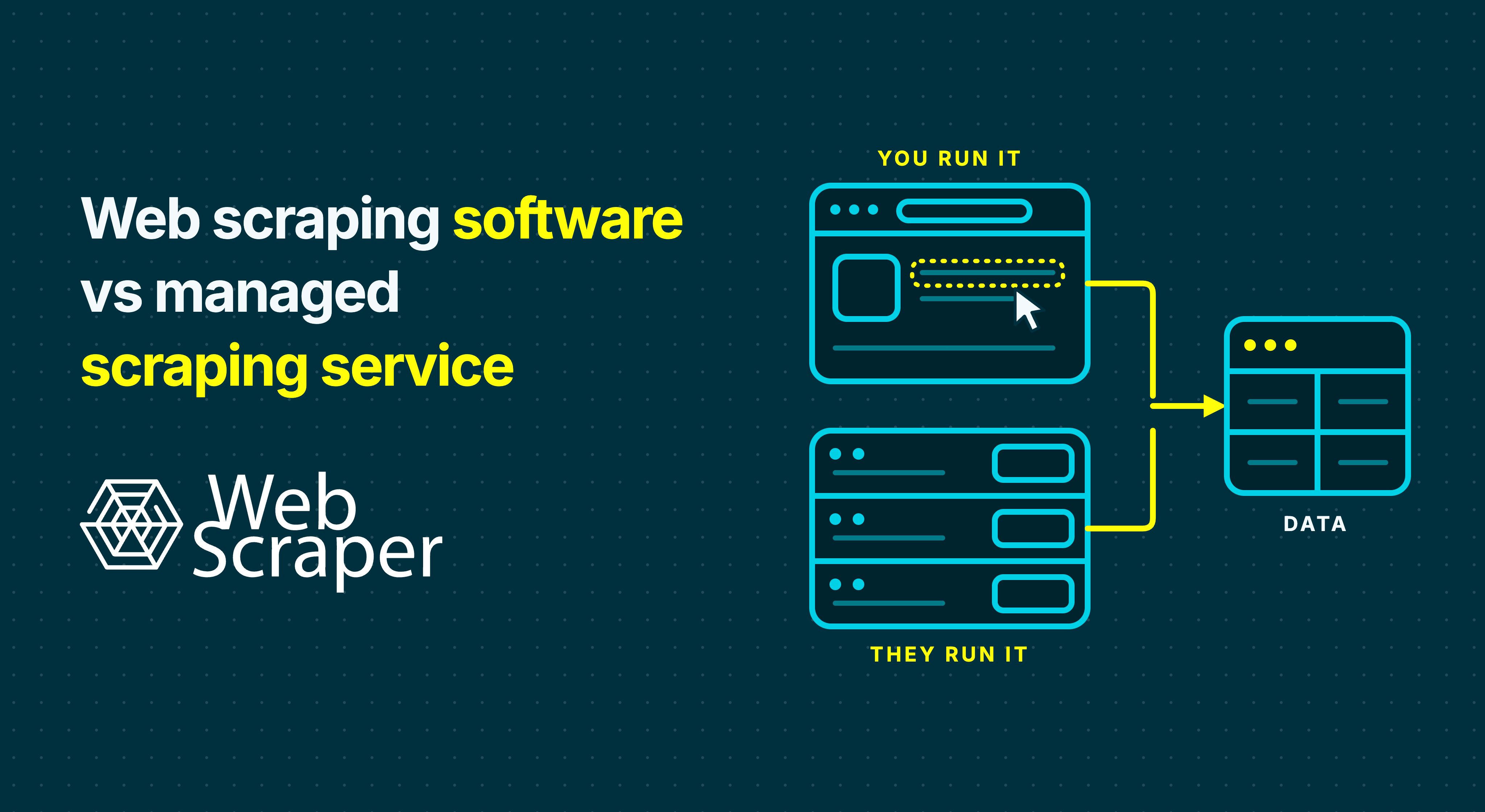
Web scraping software gives your team direct control over how a dataset is collected and maintained. A managed scraping service takes on more of the target-specific work and delivers data against an agreed scope.
For recurring public data, self-service software is often the stronger starting point when someone can own the scraper. Choose a managed service when the real requirement is to outsource configuration, repairs, quality assurance and delivery, not simply to run scraping jobs in the cloud.
Web scraping software vs managed scraping service at a glance
The main difference is ownership. With software, your team normally defines and maintains the extraction workflow. With a managed service, the provider operates the target-specific workflow within the contract, while your organisation still defines what it needs and decides whether the result is acceptable.
| Responsibility | Web scraping software | Managed scraping service |
|---|---|---|
| Business purpose and source scope | Customer | Customer |
| Schema and field meaning | Customer | Customer approves; provider may help design |
| Target-specific extraction logic | Customer | Provider, within the agreed scope |
| Browsers, servers and proxies | Customer for local software; vendor for a cloud platform | Provider |
| Schedules and retry settings | Customer configures | Provider configures within the service terms |
| Repair after a website change | Customer | Provider, if included |
| Data-quality rules | Customer defines and configures | Customer defines or approves; provider implements |
| Final dataset acceptance | Customer | Customer |
| New sources, fields or frequency | Customer changes directly | Change request, possibly at extra cost |
| Delivery | Customer configures and maintains the receiving system | Provider delivers to the agreed interface; customer maintains the receiving system |
| Exit and portability | Customer preserves data, configuration and documentation | Contract should define data return, documentation and transition support |
Managed services vary, and self-service products range from local browser extensions to cloud platforms. Treat the table as a starting point for evaluation, not as a substitute for the actual service terms.
Managed infrastructure is not a managed scraping service
The word “managed” creates confusion because it can describe two different operating boundaries.
A managed cloud platform can operate browsers, queues, proxies, retries, storage and scheduled execution. It removes the need to build and maintain that general infrastructure. The customer may still decide how to navigate each website, which elements represent records, which fields to extract and how to respond when a layout changes.
A managed scraping service goes further. Its team builds and maintains the target-specific extraction, monitors deliveries and provides the finished dataset within an agreed scope.
Web Scraper is a self-service platform with managed cloud infrastructure. The user builds and tests a sitemap, while Web Scraper Cloud can run that existing sitemap remotely with scheduling, proxy management, retries, monitoring, parsers and delivery options. Its API launches an existing sitemap; it is not an arbitrary URL-to-dataset service.
This boundary suits teams that want to stop operating scraping infrastructure without giving up direct control of the extraction logic.
Compare time to accepted data and change turnaround
Either model can produce a quick demonstration. The better measure is the time required to deliver the first dataset that the business can accept.
Software can be faster when an operator is available, the source is accessible and requirements are still changing. The team can adjust navigation or field selection and test the result immediately.
A managed service can be faster when the buyer has no suitable operator or the project would otherwise wait in an engineering backlog. However, discovery, sample approval, procurement and security review may happen before production delivery.
Ongoing change is just as important as initial setup. Separate three types of work:
- Source repair: An agreed website changes its layout or access behaviour.
- Requirement change: The buyer adds a field, source, region, frequency or delivery format.
- Platform or service incident: Shared infrastructure or delivery is impaired.
With software, your team can make changes directly but must supply the skills and availability. With a managed service, turnaround depends on support hours, severity definitions, commercial scope and change-control terms. An incident SLA may not include new requirements.
Define an accepted dataset before comparing reliability
A completed scraping job is not automatically a correct dataset. A page can return 200 OK while showing a consent screen, login page, challenge or reduced response instead of the required content. Our guide to 200 OK responses with no useful data explains why retrieval, rendering, extraction and validation are separate checks.
The UK Government Data Quality Framework separates dimensions such as completeness, uniqueness, consistency, timeliness, validity and accuracy. The useful combination depends on the business purpose.
For a recurring product dataset, the acceptance contract might define:
- the expected catalogue or source coverage;
- whether one record represents a product or a variant;
- required identifiers, source URL, price, currency and availability;
- rules for optional and conditionally missing fields;
- maximum duplicate and invalid-value rates;
- the required region, language and website state;
- the delivery deadline and freshness timestamp; and
- how values will be sampled against source pages.
Web Scraper Cloud can monitor minimum record count, failed and empty page percentages and field completion through its data-quality controls. These guardrails can reveal silent drops in output. They cannot determine whether a captured value has the correct commercial meaning, such as whether it is a standard, member or promotional price.
For a managed service, turn the same rules into service commitments. Clarify whether the agreement covers platform availability, job completion, on-time delivery or dataset acceptance. Ask what evidence accompanies a rejected delivery, how quickly it will be reprocessed and which remedies apply.
Compare total cost on the same boundary
A software subscription and a managed-service quote pay for different work. Comparing only the invoices makes software look artificially cheap and a service look artificially expensive.
For software, calculate:
subscription and add-ons + configuration and integration + monitoring and maintenance + validation + expected failure cost
For a managed service, calculate:
contract fee + setup + change or out-of-scope charges + retained acceptance and governance work + downstream integration + exit support
Then normalise both options against the same sources, frequency, rendering needs, schema, delivery method and acceptance rules:
cost per accepted dataset = total period cost ÷ datasets delivered on time that pass the contract
Cost per accepted record can also be useful when record definitions are identical. Do not silently convert a page-based price into a record price. One listing page may contain many records, a detail page may contain one and a blocked page may contain none.
This is why an exact software-versus-service cost per 1,000 table is not defensible without two real proposals for the same workload. A public platform price and a managed quote are not equivalent units. Our guide to estimating the real cost of a web scraping project provides a fuller total-cost model.
Consider portability, governance and compliance
Both models create dependency, but in different forms.
With software, target logic may rely on a proprietary configuration, integration or one employee’s knowledge. With a managed service, the provider may hold most of the knowledge about target behaviour, exceptions and repair history.
Retain enough information to change models later:
- source inventory and representative URLs;
- current schema and field definitions;
- accepted sample datasets;
- null-handling and normalisation rules;
- target-specific exceptions;
- quality thresholds and delivery specifications; and
- a history of material website changes.
Ask whether you can export the extraction configuration or only the data. Data portability and scraper portability are different questions.
For either model, review security, data locations, retention, access controls, subprocessors and incident reporting. Technical access does not establish permission to collect or use data. Website terms, privacy, copyright and applicable law still require case-specific review.
Where personal data and UK GDPR apply, the Information Commissioner’s Office says controllers must assess processors, put suitable contracts in place and monitor compliance. The exact roles depend on the facts, so do not assume every scraping provider has the same legal position.
Which operating model should you choose?
Choose self-service scraping software when:
- someone can own the sitemap and validation rules;
- sources and requirements change often enough that direct editing matters;
- transparent field mapping and failure diagnosis are valuable;
- the data comes from repeatable, accessible public pages;
- the organisation wants to retain target knowledge; and
- managed cloud execution removes enough infrastructure work.
Choose a managed scraping service when:
- the organisation does not want target-specific scraper ownership in-house;
- the provider must build, monitor, repair and deliver the dataset;
- internal availability is a larger constraint than software capability;
- custom transformations or human review are required; and
- the service, change and exit terms justify the dependency.
Neither company size nor page volume decides the answer. A large catalogue with a few stable templates can be a strong software fit. A smaller portfolio of highly variable sources may justify managed ownership.
A hybrid model can also work. Keep stable sources in a self-service platform and outsource only difficult targets, use managed execution while retaining internal validation and business logic, or buy initial setup help with a documented handover. Make failure ownership explicit so the provider cannot declare retrieval successful while the customer rejects the data with neither party responsible for closing the gap.
Run the same production-like pilot for both options
A pilot should test the operating model, not one easy page.
Use the same sources, schema, frequency, region, delivery destination and acceptance rules. Include pagination, linked detail pages, JavaScript states, optional fields, alternate layouts, empty categories and known access difficulties. Run several refreshes rather than one demonstration.
During the pilot, request one realistic change, such as adding a field or regional source. Measure:
- time to the first accepted dataset;
- internal hands-on hours and provider response time;
- source coverage and required-field completion;
- duplicate and invalid-value rates;
- sampled value correctness;
- on-time delivery;
- diagnosis and repair time;
- change-request turnaround;
- cost per accepted dataset; and
- documentation and export artefacts available at exit.
Ask a software vendor how extraction logic is edited and exported, how failed and empty pages are reported, how JavaScript and interactions are handled, and how usage is measured.
Ask a managed provider whether commitments apply to processed pages, delivered records or accepted datasets; whether ordinary repairs are included; which changes cost extra; which failure evidence is available; who owns the configuration; and how the workload can be brought in-house.
Set pass and fail thresholds before the pilot begins. Otherwise, each option can be judged against a different definition of success.
Keep control of the scraper without running the infrastructure
For recurring structured data from accessible e-commerce sites, marketplaces, job boards, directories and real-estate pages, Web Scraper offers a practical self-service model: your team owns an editable sitemap while Cloud handles the recurring execution layer.
Build one representative sitemap locally, define the acceptance rules and use the seven-day Web Scraper Cloud trial to test scheduling, access, quality thresholds and delivery on the real target. Cloud supports Fast for raw-HTML workflows and FullJS when required data depends on JavaScript rendering or supported interactions.
No driver, proxy or retry strategy guarantees compatibility with every website. Web Scraper is not the default fit for social platforms, LinkedIn or large behind-login projects. If the representative pilot works and your organisation can own the sitemap, the platform keeps changes direct while removing much of the infrastructure burden. If nobody should own those target-specific responsibilities internally, choose a managed service and make its output, maintenance and exit terms explicit.